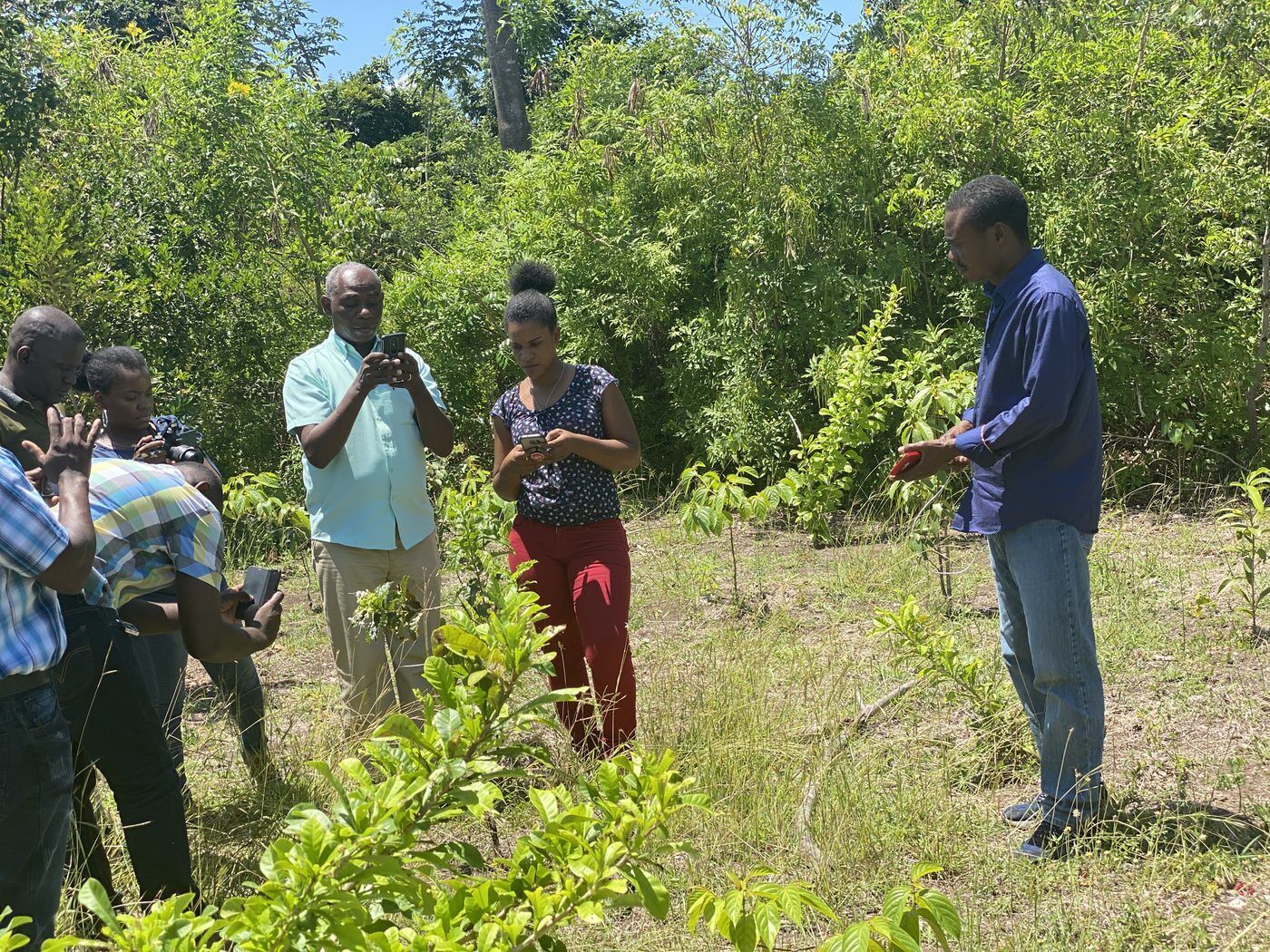
Today, with artificial intelligence, smartphones and identification apps, it has become very easy to take a photo of a plant and quickly obtain a scientific name, a common name or a suggested identification. This technology is useful. It can help students, enthusiasts, gardeners, researchers, farmers and the curious to begin a search. But there is a danger: to believe that knowing the name of a plant means understanding the plant.
Naming a plant is not the same thing as understanding it.
The scientific name is important. It makes it possible to identify the species, to connect it to a botanical family, to scientific data, to a geographical distribution, to uses and to references. Without a correct name, it is difficult to build solid knowledge. But if our relationship with plants stops at the name, we lose something much deeper: the ability to observe, to understand and to develop a connection with nature.
Today, technology gives us quick answers. But nature demands slow attention. An app can tell the name of a plant, but it cannot always teach you to sense its environment, to understand why it grows in this place, why its leaves have this shape, why its flowers have this color, why its roots explore this soil, why it attracts certain insects, why it defends itself with thorns, latex, smells, toxins or particular molecules.
When you focus only on the name, you risk staying at the surface. You see a plant as a label. But when you learn to decode a plant, you enter its world. You begin to observe its form, its structure, its strategy, its interactions, its habitat, its role in the ecosystem and its way of surviving.
To understand a plant is to ask: why is this plant here? Why does it grow in this soil? Why are its leaves thick, thin, wide, cut or opposite? Why are its flowers red, yellow, white, fragrant or discreet? Which insects visit it? Which animals eat its fruits? Is it medicinal, toxic, edible, aromatic, honey-producing or useful for soils? Is it native, endemic, introduced or invasive? What does it teach us about the territory?
Plants, silent masters
Plants are true silent masters. They teach patience, adaptation, resilience, cooperation and creativity. They do not speak like humans, but they communicate through their forms, their colors, their smells, their molecules, their flowers, their fruits, their seeds and their relationships with other living beings.
In a world where humans are drifting further and further from nature, learning to observe and understand plants becomes a form of return to the essential. Nature can become a therapy for thought. Being in regular contact with plants can help to slow down, observe, reflect, create and better understand life. The colors of flowers can inspire design. The shapes of leaves can inspire architecture. The defense strategies of plants can inspire innovation. The interactions between plants, insects, fungi and animals can inspire new ways of thinking about human systems.
A plant is a living school.
It teaches us how to transform the elements of the soil, water, air and solar energy into living matter. Thanks to photosynthesis, plants capture the light of the sun and transform it into energy. They produce sugars, build their tissues, nourish other living beings and support almost the entire chain of life on Earth. Behind a simple green leaf lies an extraordinary natural technology.
Plants also teach us memory and continuity. Some seeds can remain dormant for years before germinating. They carry within them genetic information, a history, a possibility of reproduction and a promise of the future. A seed can seem dead, but it can contain a forest in waiting. It reminds us that life can wait for the right moment, the right conditions, the right moisture, the right light and the right soil to begin again.
Identifying or understanding?
That is why Botapreneurs insists on an important idea: we must not only learn to identify plants. We must learn to understand them.
To identify is to ask: what is the name of this plant? To understand is to ask: what does this plant teach me?
To identify is to look for an answer. To understand is to develop a relationship.
To identify is to use information. To understand is to grasp a system.
To identify is useful to begin. To understand is essential to become a Plant Master.
The Plant Master is not only the one who memorizes scientific names. It is the one who observes the patterns, the families, the forms, the uses, the molecules, the habitats, the interactions and the strategies. They understand that every plant can become a source of knowledge, of innovation, of health, of education, of economy and of ecological restoration.
Using technology without losing observation
In this age dominated by artificial intelligence, databases and digital tools, we must use technology without losing our capacity for observation. AI can help us find a name. Databases can help us verify identity. Platforms like GBIF, POWO, WFO, iNaturalist or digital herbaria can help us document plants. But true botanical intelligence begins when the human returns to the field, observes the plant, listens to the landscape and learns to understand what nature teaches.
Technology can give us the name of a plant. But only deep observation can teach us its lesson.
The world does not only need people able to name plants. It needs people able to observe plants, to understand ecosystems, to respect the knowledge of the living and to turn this knowledge into solutions for health, food, agriculture, conservation, innovation and sustainable development.
So stop only naming plants.
Learn to understand them.
Because a plant is not only a name in a database. It is a living strategy, a natural library, a source of creativity, a genetic memory and a gateway to a deeper relationship with nature.