I am William Cinéa, botanist-entrepreneur, founder of Botapreneurs, of the Jardin Botanique des Cayes and creator of the Plant Mastery program. My journey with plants was not born in a laboratory. It began very early, in the heights of Maniche, a small locality in the Southern department of Haiti, where I grew up in contact with the land, the trees, the crops, the animals and rural life.
A passion born in a family yard
From a young age, I developed a deep passion for plants. When I was still in secondary school, I already loved landscaping my parents’ home. I planted grass, I created hedges, I planted trees to provide shade and I took care of the plants around the house. At that time, I did not yet know that this passion would become a life mission. But I already knew that plants had the power to transform a space, to bring beauty, freshness, shade, life and pride.
I grew up in a family where the relationship with nature was a daily one. My parents practiced agricultural activities, planted, harvested, took care of animals and lived in direct relationship with the environment. This experience gave me my first school: the school of the field. Even before studying botany in books, I had already learned to look at plants as useful living beings, present in the life of families, in food, in agriculture and in the identity of a territory.
Very young, I also developed another passion: books. I read about psychology, history, politics, the great thinkers and the great figures of humanity. I had this curiosity to understand the world, ideas, societies, people and nature. Over time, this double passion — plants and books — built my way of thinking: observe, read, reflect, understand, act and pass on.
1994: the flower that becomes a world
In 1994, I entered the École Normale Supérieure in Port-au-Prince. I was the top of my class, and I felt I had a responsibility: to prove that I had the ability to succeed, to understand and to bring something serious. From the very first weeks, a botany professor asked us to prepare a presentation on the organs of plants. The class had been divided into groups, and each group had to study a part of the plant.
This assignment was an important turning point in my life. At that time, there was no easy access to the Internet as there is today. You had to go to libraries, look for books, read, take notes, understand complex botanical vocabulary and organize information. I remember that the flower particularly struck me. I had to understand the petals, the sepals, the stamens, the pistil, the ovary, the style, the stigma and the whole hidden architecture of the flower.
But I have never been someone who is content with books alone. I needed to see. I went out into gardens, into the spaces where there were plants, to observe the flowers directly. I wanted to open, compare, touch, look and understand. The flower was no longer only beautiful: it became a reproductive structure, an attraction strategy, a scientific language and a gateway to botany. This moment reinforced my conviction: you do not understand plants only by memorizing names. You must observe them, analyze them, compare them and connect them to their environment.
1995: forestry in the Dominican Republic
In 1995, I obtained a scholarship to go study in the Dominican Republic. I was selected among the students who were going to train in fields such as agriculture, animal production and forestry. I chose forestry, because I wanted to deepen my relationship with trees, forests, soils, ecosystems and plants.
There, I continued to develop my knowledge of plants. Botany, forestry and field observation took an important place in my training. I learned to recognize species, to understand families, to observe trees, to study ecosystems and to connect the plant to its environment.
2000: Haïtivert and the return to action
In 2000, after my studies, I returned to Haiti with the desire to put my knowledge into practice. That same year, I launched Haïtivert, my first initiative, with the goal of contributing to the reforestation of Haiti. For me, it was not enough to have studied plants. I had to act. I had to plant, restore, train, raise awareness and show that plants could play a role in the ecological reconstruction of the country.
2003: the beginnings of a garden
In 2003, a new stage began. Inspired by my experiences, my travels and my vision, I decided to lease a plot of land to start a garden. At first, it was not yet a botanical garden in the scientific sense: it was above all a collection of plants, a space of attraction, a place where people could come to walk, look, discover and feel the beauty of the plant world.
From 2003 to 2009, I worked to develop this space with passion. In a difficult context, with very few resources, I began to build a place that would gradually become a source of pride for many people. Visitors came to discover the plants, to stroll, to admire the space and to understand that in Haiti too, it was possible to create an inspiring garden.
2009: Kew, and everything changes
My vision changed profoundly in 2009. That year, I had the opportunity to go to Kew Gardens, in London, to follow a specialization in botanical garden management. I also visited other institutions such as the botanical gardens of Cambridge and Oxford, as well as the Eden Project. This experience transformed my understanding. I understood that a botanical garden is not only a beautiful green space. It is a scientific institution: a place of research, conservation, education, living collections, data, training, culture and transmission.
On my return, my vision of the Jardin Botanique des Cayes changed. I no longer wanted only to build a space of beauty. I wanted to build an institution capable of contributing to research, conservation, education, the valorization of plants and the development of the country.
2011: Cornell
In 2011, I had the opportunity to go to Cornell University thanks to a scholarship from the American embassy. At Cornell, I deepened my understanding of the link between universities, botanical gardens, research, education and institutional leadership. I understood that a botanical garden could become a bridge between science, society, students, communities and decision-makers.
The National Botanical Garden of Haiti
After Cornell, I took part in the reflection and the launch of the project for a National Botanical Garden of Haiti. This vision was supported by great thinkers, botanists, researchers and leaders of the botanical garden world. Figures such as Peter Wyse Jackson, Gilles Vincent of the Montreal Botanical Garden, as well as other international experts, came to Port-au-Prince to support this idea and contribute to opening a new reflection on the role of botanical gardens in Haiti.
These encounters marked me deeply. They showed me that botanical gardens are not only spaces of plants: they are strategic institutions capable of contributing to conservation, research, education, environmental diplomacy, data and national development.
Training in everything: the birth of the botanist-entrepreneur
Developing such an institution in a difficult context requires more than knowledge of plants. You must learn management, leadership, entrepreneurship, communication, resource mobilization, strategy and value creation. That is why I began to train in several directions. I took botany training in the United States, in Costa Rica and in other countries to deepen my knowledge of plants and gradually become a Plant Master. But I also took training in entrepreneurship, leadership, strategy, management and institutional development.
My personal library reflects this double orientation. About 60% of my books are about entrepreneurship, leadership, strategy, personal development, management and the creation of institutions. The other 40% are about plants, botany, conservation, botanical gardens, research, ecosystems and biodiversity. This combination has become my strength.
My mentor’s advice
A piece of advice received at Cornell also changed my trajectory. As I was thinking about pursuing a doctorate after my master’s, I discussed it with my mentor, Peter Wyse Jackson, during a meeting at the Missouri Botanical Garden. I explained to him that I wanted to pursue doctoral studies. He advised me to also consider business, management and entrepreneurship, because the vision I carried needed a capacity for institutional development.
This advice marked me greatly. I understood that the knowledge of plants gives depth, diversity, understanding and potential. But entrepreneurial knowledge gives vision, energy, strategy and the ability to transform this potential into action.
Entrepreneurial botany
This is how my vision of entrepreneurial botany was gradually built. For me, entrepreneurial botany is not a theoretical idea. It is the result of my journey, my studies, my mentors, my travels, my readings, my conferences, my experiences, my difficulties and my actions. It is a way of saying that plants must not only be studied. They must also be valued, protected, taught and transformed into solutions for health, food, agriculture, conservation, education, well-being, innovation and the green economy.
2013: on the world’s stages
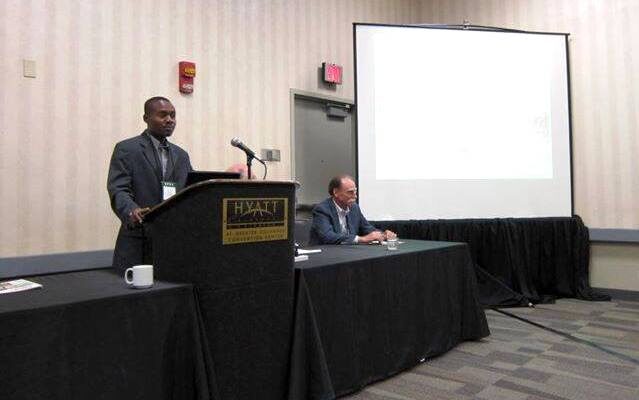
In 2013, I gave my first major international presentation as a speaker in Ireland, around the vision of botanical gardens. Since then, I have been invited to speak at international congresses, conferences and meetings on botanical gardens, conservation, botanical data, plant entrepreneurship and the role of plants in development. These conferences allowed me to share my experience, but also to learn from other institutions, other countries and other thinkers of the plant world.
During a presentation in Qatar, one remark particularly touched me. After listening to me, a Malagasy entrepreneur said to me: “Mr. Cinéa, you have done something extraordinary. With less than 50 dollars, you launched a project that ended up shining on an international scale. What you have in your hands are projects worth millions.”
This sentence confirmed what I already knew: plants represent extraordinary opportunities. But to see these opportunities, you must know how to observe plants. You must understand their cross-cutting nature, their link with health, food, ecology, education, well-being, conservation, data and entrepreneurship.
2024: back to Cornell, and a trial
In 2024, I returned to Cornell University to pursue a master’s degree in plant sciences and botanical garden leadership. This new stage allowed me to strengthen my mission: to contribute to transforming botanical gardens into institutions capable of producing knowledge, training young people, creating enterprises, developing data and supporting human health and the health of nature.
During this period, I also launched a new vision for the Jardin Botanique des Cayes. The garden I had built over several years was vandalized. This reality was painful. But it did not stop me. On the contrary, it pushed me to transform the institution even further.
From the physical garden to the data institution
I understood that a botanical garden must not only exist as a physical space. It must also become an institution of memory, data, knowledge and decisions. That is why I began to orient the Jardin Botanique des Cayes toward a new mission: to become a data institution on the environment, nature and plants in Haiti.
Today, despite the difficulties, the Jardin Botanique des Cayes remains a living memory of the environment, nature and plants in Haiti. It continues to innovate through its mission: to contribute to human health and the health of nature.
Botapreneurs and Plant Mastery
It is in this continuity that I created Botapreneurs and the Plant Mastery program. Botapreneurs was born from a conviction: botany must become more accessible, more practical, more useful and more entrepreneurial. The world needs people capable of understanding plants, observing them, protecting them, valuing them and transforming this knowledge into concrete projects.
Plant Mastery is a response to this need. A Plant Master is a person who learns to observe and understand plants with method. They are not content with memorizing scientific names: they observe the shapes, the families, the leaves, the flowers, the fruits, the seeds, the roots, the scents, the latex, the habitats, the uses, the risks, the molecules and the adaptation strategies. A Plant Master understands that each plant carries a story, an ecology, a chemistry, a usefulness, a risk and an opportunity.
The Botapreneur, in turn, transforms this understanding into action. They create training, services, products, databases, gardens, content, restoration projects, landscaping solutions, educational programs or enterprises linked to plants.
Seeing plants differently
My journey has taught me that plants can transform a life. They can also transform a community, an institution, a university, a business and a country. But for that, you must understand them differently.
Today, through my conferences, I share this vision with young people, universities, businesses, institutions, botanical gardens, NGOs, communities and decision-makers. I speak of botany, but also of leadership. I speak of botanical gardens, but also of institutional development. I speak of plants, but also of innovation. I speak of conservation, but also of entrepreneurship.
If you are organizing a conference, a training, a congress, a university event, a seminar on nature, a youth meeting, a botanical garden activity or a program on plant entrepreneurship, I can help you convey a strong, living and mobilizing message. Contact Botapreneurs specifying the theme, the audience and the format of your event.
My goal is simple: to help people see plants differently. Plants are not only decoration. They are sources of life, health, food, innovation, conservation, data, well-being, economy and future.
Plants have transformed the planet. They can also transform our way of thinking, educating, undertaking and acting.