By William Cinéa — Botanist: conservation, research, ecosystem restoration and education.
If you want to understand the deep links between botany, pharmacology, ecology and ethnobotany, it is essential to draw inspiration from the greatest. Jean-Marie Pelt (1933-2015) is undeniably one of these foremost role models. Personally, this exceptional man of science has deeply influenced my way of thinking and acting and, more broadly, my vision of the botanist’s career.
I hope he will inspire you in turn. Above all, his journey reminds us of one essential truth: botany is not a science of the past. It remains a living science, capable of addressing the great challenges of our time.
From pharmacy to a global vision of the plant world
Born in 1933 in Thionville and passing away in 2015, his academic path commands respect: Doctor of Pharmacy in 1959, then agrégé in 1961. But very early on, his scientific path opened toward the natural sciences, botany, plant biology and pharmacognosy.
It is precisely this ability to refuse the compartmentalization of the sciences that fascinates me about him. Jean-Marie Pelt did not abandon pharmacy to become a botanist, then abandon botany to become an ecologist. He built bridges between these disciplines. A plant could be studied as a living organism, as a component of an ecosystem, but also through its molecules, its properties, its uses and its relationships with human societies.
This approach led him to ethnopharmacology. His international missions, particularly in Afghanistan and Yemen, led him to focus on traditional pharmacopoeias, succeeding in scientifically validating in the laboratory nearly 75% of the empirical medicinal uses studied. A man of deep conviction, he co-founded the French Society of Ethnopharmacology and fought relentlessly to defend the herbalist profession, severely affected by the abolition of its official diploma in France in 1941.
Here is a first major lesson for the new generations: systemic and holistic thinking. Being a botanist does not mean only collecting, identifying and classifying. Botany must engage in dialogue with ecology, medicine, pharmacy and phytochemistry.
Leadership, responsibility and scientific entrepreneurship
Jean-Marie Pelt did not only want to understand nature. He wanted that knowledge to help transform society.
His thinking placed strong emphasis on the interdependence of life, on solidarity, and on the responsibility of humans toward nature. He defended a profoundly humanist ecology: protecting nature did not mean excluding humans, but rethinking their place and their responsibilities. This philosophy appears in several of his works, notably L’Homme re-naturé (European Prize of Ecology), La Vie sociale des plantes, La Terre en héritage and La Solidarité chez les plantes, les animaux, les humains.
But what makes his journey even more powerful is that he sought to translate his convictions into action. When you study nature and see things that others do not yet see, you cannot stay silent. In 1971, he became a builder and founded the European Institute of Ecology in Metz. He also held municipal responsibilities and became deeply involved in environmental and urban-ecology issues, reintegrating water and green spaces into the heart of the city. His leadership also expressed itself through his struggles: he co-founded CRIIGEN to demand transparency on GMOs and campaigned tirelessly against the destructive use of pesticides.
Another fundamental lesson: science confers a moral duty to act. When a scientist understands the importance of biodiversity, they must get involved, rally others and build in order to weigh on public decisions.
Communication and the spread of knowledge
This is probably where Jean-Marie Pelt influenced me the most. He could have remained a professor and researcher, but he chose to elevate transmission to the rank of a vital mission.
He was one of the first to dare to publicly debate the sensitivity and the “intelligence” of plants. He wrote many books, including La Médecine par les plantes, which won a prize from the Académie française, and his immense work of popularization was recognized by the Jean-Perrin Prize.
He also used television and radio to educate the general public. His television series L’Aventure des plantes (awarded a Sept d’or) and his unmistakable voice on the France Inter show CO2 mon amour remain unforgettable. I never met Jean-Marie Pelt, but he has influenced me every day through what he took the time to write and record. A scientist may pass away, but what they have transmitted continues to educate generations.
An immense field of research awaits us
Today, we sometimes hear that botany is disappearing. I believe exactly the opposite. I deeply hope that new generations of physicians, pharmacists, ecologists and botanists will decide to study plants with the same depth, to better valorize and protect them.
Jean-Marie Pelt cleared this path for us; it is up to us to continue it and to bring even more light to it. He has left us with a fascinating scientific challenge: while we have identified the molecules that plants produce, we are still far from unraveling the mystery of why they produce them. The field of research opening up before us is enormous.
Find your role models, then build your own path
This is ultimately the message I want to convey. When you want to build a career, find role models. Study their journeys. Observe how they overcame the boundaries between disciplines and how they turned knowledge into action. It is not about becoming a copy, but about understanding what their path can teach us.
Jean-Marie Pelt’s field of study and influence were of such magnitude that his imprint is etched in the stars: an asteroid now bears his name, (38019) Jeanmariepelt.
The ideas he sowed continue to germinate. This may well be one of the finest legacies a scientist can leave. Botany is alive. It is up to us to keep it alive.
William Cinéa — Botanist: conservation, research, ecosystem restoration and education.
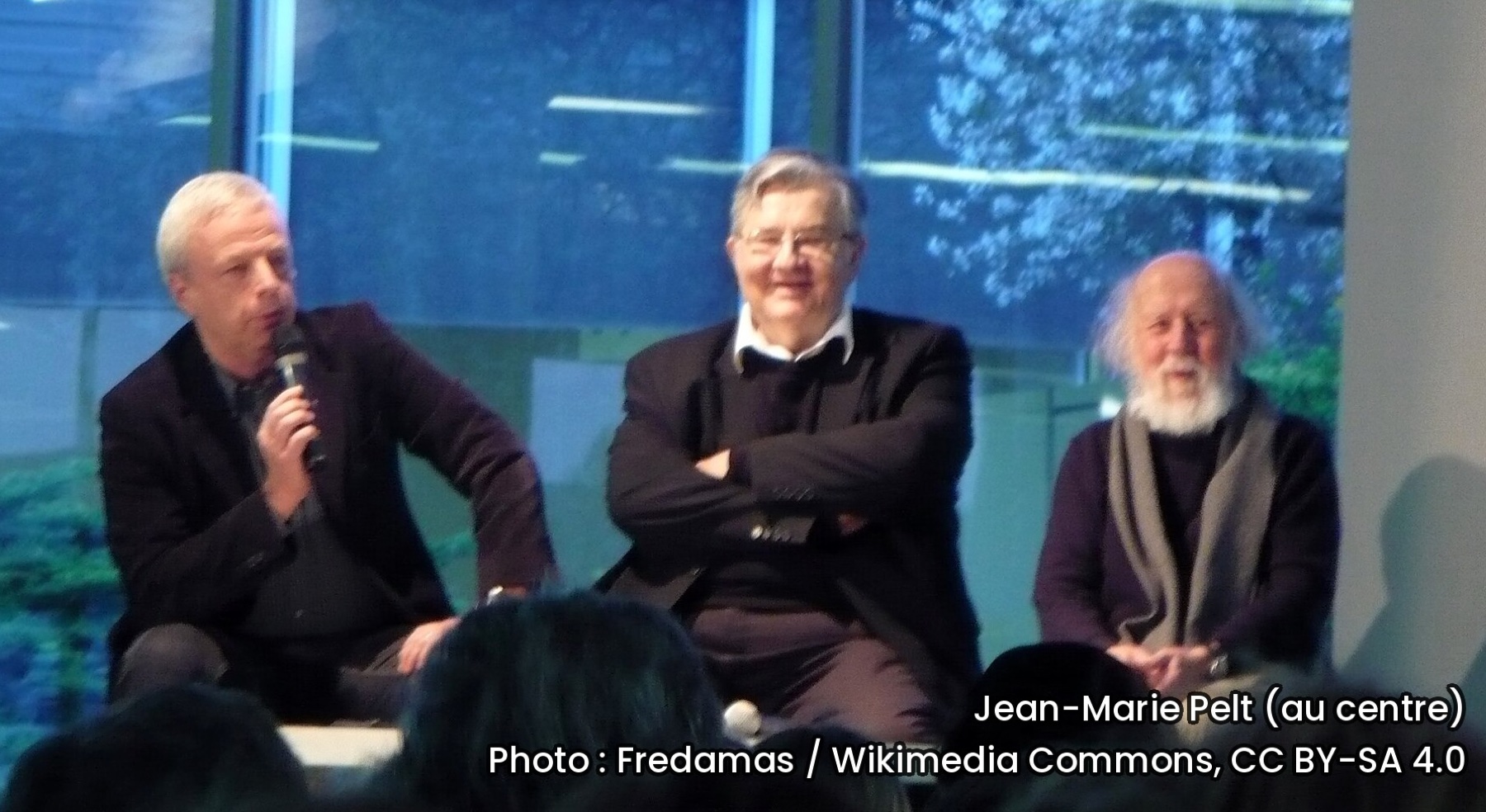
Portrait of Jean-Marie Pelt: Fredamas, CC BY-SA 4.0, via Wikimedia Commons — cropped by Botapreneurs.